
What Type of Psychotherapy Is Best for Anxiety?
Anxiety is one of the most common mental-health challenges today, and thankfully, it’s also one of the most treatable. With so many therapy options available, it’s natural to wonder which approach actually works best. The truth is that the most effective therapy depends on the type of anxiety you’re experiencing, your symptoms, and what feels right for you.
In this article, you’ll learn exactly how the leading psychotherapies for anxiety work, which ones have the strongest scientific support, and how to choose the approach that aligns with your needs, goals, and comfort level.
Which Psychotherapy Is Best for Anxiety?
There is no single “best” psychotherapy for everyone with anxiety. Cognitive Behavioral Therapy (CBT) has the strongest overall evidence and is the most widely recommended, but other approaches, such as Exposure Therapy, Acceptance and Commitment Therapy (ACT), mindfulness-based therapies, psychodynamic therapy, and EMDR, can be equally effective depending on your specific anxiety disorder, your symptoms, and your personal preferences.
How Anxiety Disorders Differ?
Anxiety isn’t a one-size-fits-all condition. In fact, the type of anxiety you have plays a huge role in determining which psychotherapy is most effective. Some approaches are ideal for fears and phobias, while others work best for chronic worry or trauma-related anxiety.
Common anxiety-related conditions include:
Generalized Anxiety Disorder (GAD): Persistent, uncontrollable worry, physical tension, restlessness.
Panic Disorder: Sudden panic attacks, fear of future attacks, physical symptoms like chest tightness or dizziness.
Social Anxiety Disorder: Intense fear of judgment, embarrassment, or social interaction.
Specific Phobias: Strong fear of specific objects or situations (flying, needles, animals, heights).
Obsessive-Compulsive Disorder (OCD): Intrusive thoughts and compulsive behaviors (treated with a specialized form of exposure therapy).
Post-Traumatic Stress Disorder (PTSD): Anxiety symptoms triggered by traumatic events (treated with trauma-focused therapies or EMDR).
Evidence-Based Psychotherapies for Anxiety: What the Research Shows
Modern research tells us that several therapies consistently reduce anxiety symptoms. Each works differently, and each has strengths depending on the disorder.
Cognitive Behavioral Therapy (CBT)
CBT is the most researched psychotherapy for anxiety and is considered the first-line treatment for many anxiety disorders. It helps you examine the connection between your thoughts, feelings, and behaviors, and teaches practical tools to break the anxiety cycle.
Best for: GAD, panic disorder, social anxiety, health anxiety, mild OCD, many forms of situational anxiety.
Why it works: It’s structured, time-limited, skill-based, and teaches lifelong coping strategies.
CBT typically includes:
Identifying anxious thinking patterns
Challenging and reframing unhelpful thoughts
Practicing new behaviors
Gradual exposure exercises
Homework to apply skills between sessions
Exposure Therapy & ERP
Exposure therapy involves facing feared situations or sensations in small, controlled steps until the fear response decreases. ERP (Exposure and Response Prevention) is the gold-standard treatment for OCD.
Best for: Specific phobias, panic disorder (interoceptive exposure), social anxiety, OCD (ERP).
Why it works: Repeated exposure retrains the brain to stop treating triggers as dangerous.
Examples might include:
Simulating panic symptoms (for panic disorder)
Gradually approaching a feared object (phobia)
Facing intrusive thoughts without performing compulsions (OCD)
This approach can feel challenging, but when done with a trained therapist, it’s one of the fastest ways to reduce anxiety.
Acceptance and Commitment Therapy (ACT)
ACT helps you accept anxious thoughts and feelings, not fight them, while taking meaningful action aligned with your values. It’s ideal for people who feel overwhelmed by constant worry or internal pressure.
Best for: GAD, chronic stress, health anxiety, worry-based anxiety.
Why it works: Instead of battling anxiety, ACT teaches you to relate differently to it so it has less control over your life.
ACT tools often include:
Mindfulness exercises
Acceptance of discomfort
Values-based goals
Cognitive defusion techniques (learning not to “hook onto” anxious thoughts)
Mindfulness-Based Therapies
Mindfulness-Based Stress Reduction (MBSR) and Mindfulness-Based Cognitive Therapy (MBCT) reduce anxiety by training your ability to stay present rather than getting pulled into rumination or fear.
Best for: GAD, stress-related anxiety, rumination, health anxiety.
Why it works: Mindfulness calms the nervous system, reduces reactivity, and improves emotional regulation.
Mindfulness-based approaches are often used alongside CBT or ACT.
Dialectical Behavior Therapy (DBT)
DBT is not exclusively an anxiety treatment, but its emotion-regulation and distress-tolerance skills can significantly help people whose anxiety is triggered by overwhelming emotions or interpersonal stress.
Best for: Anxiety with intense emotional swings, co-occurring depression, or trauma histories.
Why it works: It teaches emotional stability, grounding techniques, communication skills, and mindfulness.
Psychodynamic Therapy
This therapy focuses on understanding how past experiences, relationships, and unconscious patterns influence present anxiety. It’s especially helpful for long-standing anxiety rooted in emotional conflicts or attachment patterns.
Best for: Chronic anxiety, relationship-based anxiety, and individuals wanting deeper insight into their patterns.
Why it works: Understanding the emotional roots of anxiety helps reduce symptoms and create lasting change.
Trauma-Focused Therapies & EMDR
Trauma-focused CBT and Eye Movement Desensitization and Reprocessing (EMDR) help process traumatic memories that create ongoing anxiety.
Best for: PTSD, trauma-induced anxiety, childhood trauma, and anxiety tied to past events.
Why it works: These therapies help reprocess traumatic material safely, so it no longer triggers intrusive anxiety.
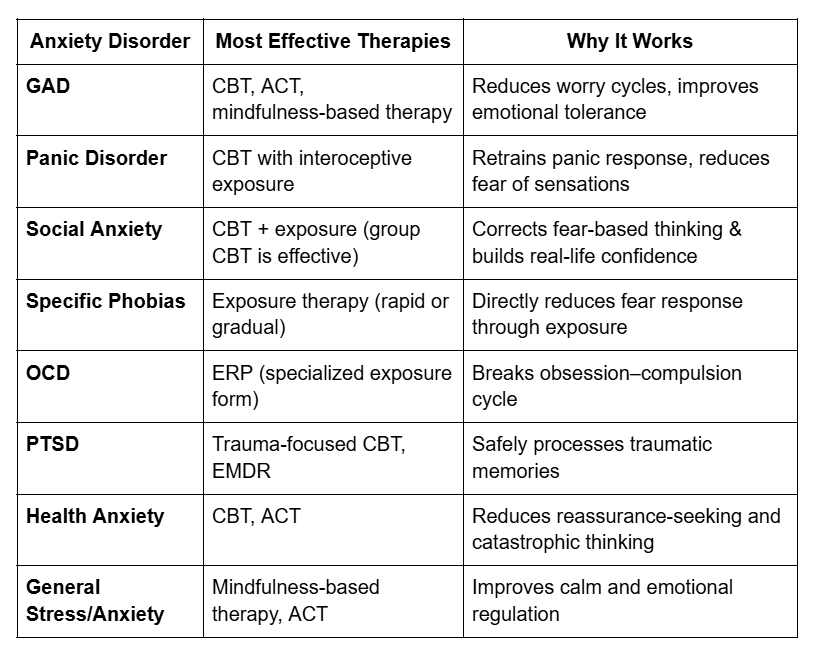
Matching the Therapy to the Type of Anxiety Disorder
Here’s a clear guide to which therapies tend to work best for each condition:
How to Choose the Right Therapy for You
Selecting the right psychotherapy can feel overwhelming, especially when you’re already dealing with anxiety. The good news is that most evidence-based therapies share the same goal: helping you feel better and regain control. What varies is how they get you there.
Here are the key factors to consider:
1. Your Specific Anxiety Symptoms
If your anxiety centers on panic attacks, phobias, trauma, or obsessive thoughts, a specialized approach like exposure therapy, interoceptive exposure, ERP, or EMDR may be most effective. If your anxiety is more general, constant worry, restlessness, tension, therapies like CBT, ACT, or mindfulness-based approaches tend to work well.
2. The Severity of Your Anxiety
Mild to moderate anxiety often responds very well to psychotherapy alone. More severe anxiety may need a combination of therapy plus medication, especially if symptoms are affecting your daily functioning.
3. Your Preferences and Therapy Style
Some people prefer structured, skills-based sessions (like CBT), while others want a deeper, insight-focused approach (psychodynamic therapy). Some love homework, others don’t. It’s essential to choose a therapy style that matches your personality and comfort level.
4. Practical Considerations
Think about access, insurance coverage, scheduling flexibility, and whether you'd prefer teletherapy or in-person sessions. Therapy is far more effective when it fits into your life without excessive stress.
5. Your Connection With the Therapist
The therapeutic relationship itself is one of the strongest predictors of success. You should feel heard, respected, and safe.
It’s perfectly okay to schedule a few consultations before committing.
What Happens in a Typical Therapy Session?
Understanding what therapy looks like can reduce a lot of anxiety about starting.
The First Session (Assessment)
Your therapist will:
Ask about your symptoms, history, and goals
Explain how treatment works
Help you determine the best therapy plan
Discuss confidentiality and logistics
Most people feel relieved after the first session simply because they’re no longer carrying everything alone.
During Ongoing Sessions
The exact structure depends on the type of therapy:
CBT: Structured sessions, worksheets, skills practice, exposure exercises
Exposure Therapy: Step-by-step facing fears, guided exercises, real-life practice
ACT: Mindfulness, acceptance strategies, values-based goals
Psychodynamic Therapy: Exploring patterns, emotions, and past experiences
EMDR: Reprocessing traumatic memories through guided eye movements
When You’ll Start Noticing Improvement
Most people feel a shift within 6–12 sessions, especially with CBT or exposure therapy. With trauma-focused or psychodynamic therapies, progress may take longer but can create deeper, long-lasting change.
When Therapy Alone May Not Be Enough?
While psychotherapy is highly effective, there are times when additional support is needed.
You may benefit from combining therapy with medication if:
Your anxiety is severe or disabling
You’re unable to function at work, school, or socially
You have co-occurring depression
You experience frequent panic attacks
You’ve tried therapy before with limited progress
Sleep or appetite are heavily affected
In these cases, a psychiatrist or primary care physician may recommend SSRIs, SNRIs, or other medications that work alongside therapy.
Therapy + medication often brings faster and more stable results for people with moderate to severe anxiety.
Taking the Next Step
If anxiety is affecting your life, work, relationships, or sense of peace, know that effective help exists, and it works. The right psychotherapy can help you regain control, build confidence, and experience real relief. Whether you’re ready to start therapy, want to explore options, or simply want guidance, reaching out to a trained professional is a powerful first step.
You don’t have to navigate anxiety alone. Support is available. Our psychiatric nurse practitioner at Serenity Telehealth offers online anxiety treatment, and you deserve to feel better.
FAQs
Q: Which psychotherapy works the fastest for anxiety?
Ans: CBT and exposure-based therapies often lead to improvement within 6–12 sessions, especially for panic disorder, social anxiety, and phobias.
Q: Can therapy cure anxiety permanently?
Ans: Many people experience long-term relief. While anxiety may not disappear forever, therapy teaches skills that prevent it from controlling your life.
Q: Is CBT or medication better for anxiety?
Ans: Both work, but they work differently. CBT teaches long-lasting tools, while medication reduces symptoms more quickly. Many people benefit most from a combination.
Q: Does online therapy work for anxiety?
Ans: Yes. Research shows online CBT and ACT are effective for many anxiety disorders. Teletherapy can be just as helpful as in-person sessions.
Q: What if I don’t connect with my therapist?
Ans: You’re allowed to switch. Finding the right fit is part of the process. A good therapist will support your decision.