
Sociopath vs Psychopath vs Narcissist: What’s the Real Difference?
Have you ever met someone who seemed cold, manipulative, or obsessively self-centered, and wondered, “Are they a narcissist, a sociopath, or a psychopath?” You’re not alone. These three terms are often used interchangeably online, yet they describe very different personality types with distinct motives and behaviors.
Exploring these differences isn’t just fascinating, it’s crucial for protecting your emotional well-being, setting healthy boundaries, and recognizing toxic patterns in relationships or workplaces.
In this article, we’ll break down what truly separates a sociopath from a psychopath, how narcissism fits into the mix, and what signs to look for when dealing with any of them.
Personality Disorders: The Big Picture
Before diving into sociopaths, psychopaths, and narcissists individually, it helps to understand where these labels come from in psychology.
Both sociopathy and psychopathy fall under a broader diagnosis known as Antisocial Personality Disorder (ASPD), a mental health condition characterized by a lack of empathy, disregard for laws or social norms, and manipulative or harmful behavior toward others.
Narcissism, on the other hand, stems from a different diagnosis, Narcissistic Personality Disorder (NPD), which focuses more on excessive self-importance, a constant need for admiration, and an inability to empathize with others’ feelings.
While these personality disorders have overlapping features, their core motivations differ:
A psychopath seeks control.
A sociopath seeks chaos or emotional stimulation.
A narcissist seeks admiration and validation.
What Is a Psychopath?
A psychopath is often portrayed as the “cold, calculating villain,” but real-life psychopaths are far more complex. Psychopathy describes individuals who exhibit chronic antisocial behavior, complete emotional detachment, and a manipulative personality.
Key Traits of a Psychopath
Lack of empathy and remorse: They can harm others without feeling guilt.
Superficial charm: Skilled at pretending to be warm or caring.
Calm under pressure: Rarely show emotional distress, even in crisis.
Manipulative and calculating: They often plan their actions meticulously.
Deceptive and controlling: Use others as tools for personal gain.
Unlike sociopaths, psychopaths are typically well-organized, intelligent, and strategic in their behavior. They may hold steady jobs or appear socially successful, masking their true nature behind a charming facade.
In psychology, experts often view psychopathy as the most extreme form of Antisocial Personality Disorder (ASPD), one that’s deeply ingrained and resistant to change.
What Is a Sociopath?
A sociopath shares many traits with a psychopath but differs in emotional control and impulsivity. Sociopaths also fall under ASPD, but their behavior tends to be more erratic, impulsive, and emotionally reactive.
Key Traits of a Sociopath
Emotional instability: Quick to anger, prone to mood swings.
Impulsive behavior: Acts without thinking of long-term consequences.
Partial empathy: May feel remorse in limited or selective situations.
Difficulty forming long-term plans: Their lives often appear chaotic or unstable.
Attachment to certain people or groups: Unlike psychopaths, sociopaths can form emotional bonds, though often in unhealthy or manipulative ways.
Sociopaths are less predictable than psychopaths. They often act out of anger or emotional reaction, making them more likely to engage in “crimes of passion” rather than calculated schemes.
What Is a Narcissist?
A narcissist is driven not by a lack of emotion, but by an excess of self-importance and entitlement. The term comes from Narcissistic Personality Disorder (NPD), a recognized psychological condition where individuals have an inflated sense of self-worth and crave constant admiration.
Key Traits of a Narcissist
Grandiose self-image: They believe they’re superior to others.
Constant need for admiration: Thrive on praise, validation, and attention.
Lack of empathy: Struggle to recognize or care about others’ feelings.
Exploitative behavior: Use people to boost their own ego or achieve goals.
Fragile self-esteem: React strongly to criticism or rejection.
There are different types of narcissists:
Grandiose narcissists: Bold, confident, and openly arrogant.
Covert narcissists: Quieter, playing the victim to get sympathy or control.
Narcissists can charm and impress others initially, but their relationships often become emotionally draining as they manipulate situations to maintain control and admiration.
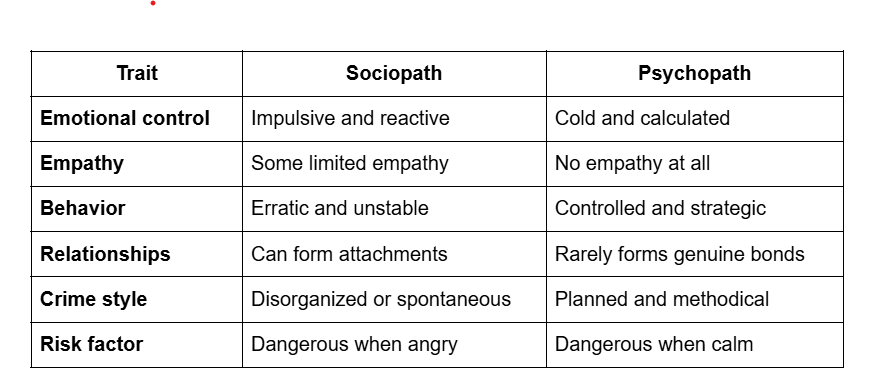
Sociopath vs Psychopath: What’s the Difference?
Although both are antisocial personalities, the difference between a sociopath and a psychopath lies in how they relate to emotions, control, and empathy.
Which Is Worse: a Psychopath or a Sociopath?
While both can be harmful, psychopaths are generally considered more dangerous because they’re emotionally detached, methodical, and often charming enough to deceive without being detected. Sociopaths, though volatile, are easier to spot due to their erratic behavior.
Sociopath vs Narcissist: Similarities and Differences
Sociopaths and narcissists share several overlapping traits: both lack empathy, manipulate others, and crave control, but their motivations and emotional depth differ.
Key Similarities
Both manipulate people for personal gain.
Both struggle with empathy and remorse.
Both thrive on control and power.
Key Differences
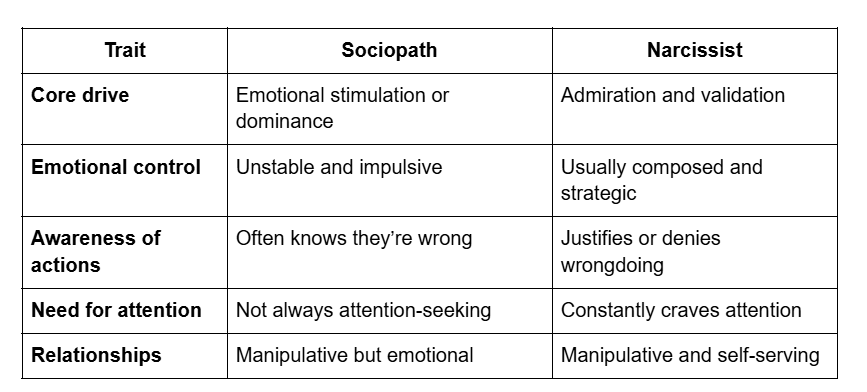
In a relationship, a sociopath might lie or cheat impulsively without much thought, while a narcissist might gaslight or devalue you to maintain control and superiority.
Narcissistic Psychopath: When Traits Overlap
Have you ever met someone who’s not only self-obsessed but also cold, calculating, and manipulative? That’s what many refer to as a narcissistic psychopath, a person who blends traits of Narcissistic Personality Disorder (NPD) and psychopathy.
While “narcissistic psychopath” isn’t an official psychological diagnosis, it’s a term often used to describe people who:
Possess an inflated ego and need for admiration, like narcissists.
Lack empathy, remorse, or emotional depth, like psychopaths.
Use charm, deceit, and manipulation as tools for power and control.
View relationships purely in terms of utility, what others can do for them.
These individuals are often the most dangerous emotionally, as they combine the social skill and charm of a narcissist with the emotional detachment of a psychopath.
They can mimic empathy, show affection when it benefits them, and discard people without hesitation when they’re no longer useful.
In essence: A narcissistic psychopath craves admiration, but feels nothing for the people who give it.
Which Is Worse: Psychopath or Sociopath?
This is one of the most common and important questions people ask.
Both are dangerous in different ways, but psychologists generally agree that psychopaths pose a greater long-term threat due to their calculated nature.
Sociopaths are impulsive and emotional. They may lash out suddenly, commit crimes of passion, or hurt others in the heat of the moment. Their behavior is erratic and easier to detect.
Psychopaths, however, are cold and methodical. They plan their actions carefully, often blending into society unnoticed. Their lack of conscience and empathy allows them to manipulate others over long periods without guilt or emotional interference.
While a sociopath might destroy your trust impulsively, a psychopath might destroy your life systematically and walk away without remorse.
How to Deal With a Narcissist, Sociopath, or Psychopath
Encountering someone with these traits can leave you emotionally drained, confused, or even traumatized. Whether it’s a partner, family member, coworker, or friend, the key is protecting your boundaries and prioritizing your mental well-being.
Here’s how to cope effectively:
1. Recognize the Signs Early
If someone consistently shows manipulation, lack of empathy, or excessive self-focus, don’t ignore the red flags. Early awareness helps you avoid deep emotional entanglement.
2. Don’t Try to Fix Them
These personality traits are deeply ingrained and resistant to change. Attempts to reason with or “heal” them often lead to more manipulation.
3. Set and Enforce Boundaries
Be clear and firm. Whether it’s emotional boundaries, communication limits, or physical space, stick to them. A narcissist or sociopath will test your limits; consistency is key.
4. Limit Contact or Go No-Contact
When possible, distance yourself. Emotional and psychological detachment is crucial. If you can’t avoid them entirely (like a coworker), keep interactions strictly factual and brief.
5. Seek Professional Support
If you’ve been deeply affected, reach out to a licensed therapist. Professionals trained in trauma recovery or narcissistic abuse can help you rebuild confidence and emotional safety.
Conclusion
Sociopaths, psychopaths, and narcissists all share a lack of empathy, but their motives, behaviors, and emotional control set them apart.
A sociopath is impulsive and emotionally volatile.
A psychopath is calm, calculated, and manipulative.
A narcissist is self-absorbed and constantly seeks admiration.
Recognizing these traits isn’t about labeling people; it’s about protecting yourself and understanding human behavior at a deeper level.
If you find yourself entangled with someone who fits these patterns, remember: it’s not your job to fix them, but it is your right to protect your peace.